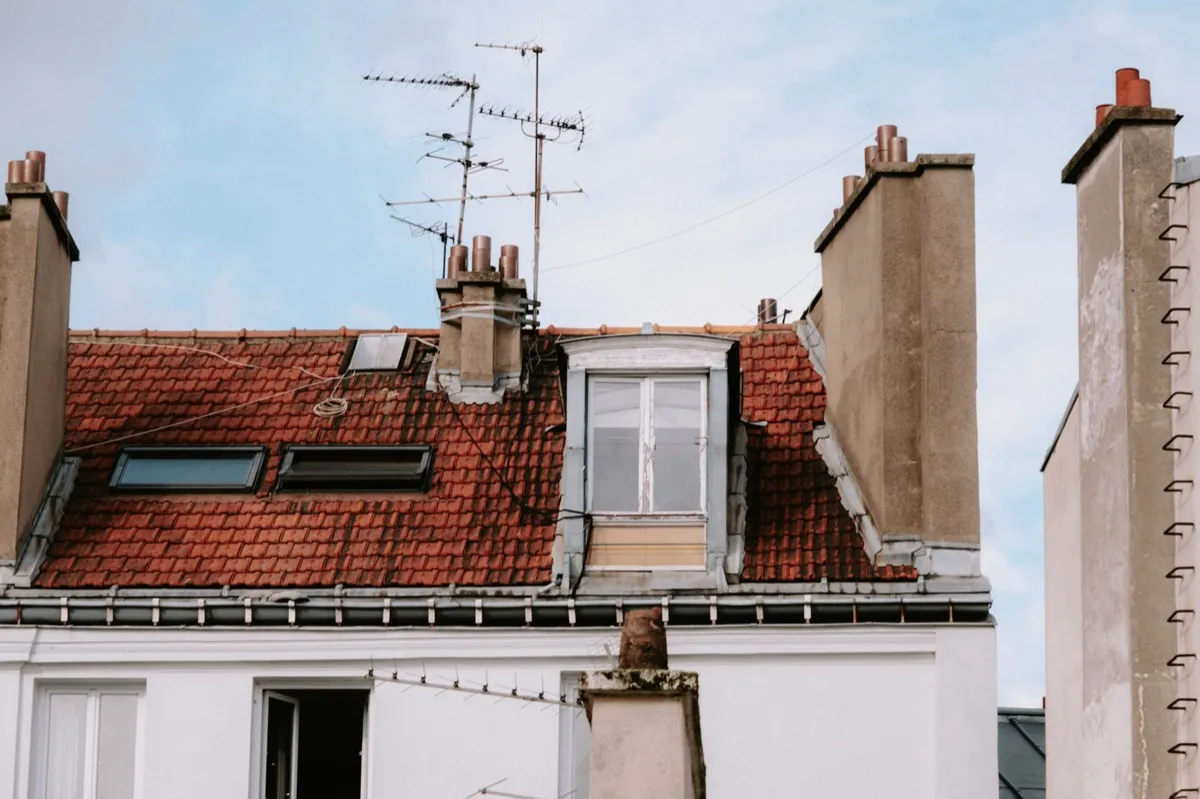
A chimney is the most expensive flashing on a roof, and it is not close. Everywhere else, flashing is one detail doing one job — a boot, an apron, a run of steps up a wall. At a chimney it is four separate pieces that have to work as a single assembly, fitted to a masonry structure with its own condition, its own trade and its own way of failing.
That is why "chimney flashing repair" prices like a category rather than a job, and why the same address can be a half day of sheet metal or the opening move in a masonry project.
Four pieces, one assembly
Water arrives at a chimney from four directions and each face needs a different answer. Flashing on a roof covers what each piece is; here is what each one does to the day.
| Piece | Where | What it adds to the job |
|---|---|---|
| Base or apron | Downhill face | The quick part — one bend, one face |
| Step flashing | Both sides | Courses off and re-laid, one piece per course |
| Cricket or saddle | Uphill face | Framing and its own flashing, inside a metal job |
| Counter-flashing | All four faces | Either masonry work or a bead of caulk — the fork |
Four pieces, and a failure at any one of them looks identical from the ceiling below. That is the structural reason the quotes vary: two contractors can both say "chimney flashing" and mean different subsets of that table.
The reglet is the fork that sets the price
Counter-flashing is the layer that comes down over the top of everything else so water running down the masonry lands outside the base flashing rather than behind it. There are two ways to attach it, and homeowners are almost never told which one they are buying.
Let into a reglet. A groove is cut into a mortar joint, the metal is bent in, wedged and sealed, and the joint is repointed around it. That is grinder work, dust, and a mason's hour rather than a roofer's.
Surface-mounted. The metal is held flat to the brick with fasteners and a bead of sealant along the top edge.
The second one takes a fraction of the time, which is the entire cost difference and most of the quality difference. IIBEC lists the reasons the detail gets skipped or downgraded and puts cost savings first, because it is labor-intensive to do properly — alongside the belief that the cap sealant on its own is enough.
It is not enough for long. IIBEC's line on exposed cap sealant is that it tears under thermal cycling and goes brittle under ultraviolet, and the guidance it quotes is blunter: sealants require continuous maintenance and should be kept out of a water-shedding design where a reasonable alternative exists.
So the two quotes are not the same product priced differently. One is a permanent detail. The other is a consumable with an inspection schedule nobody writes into the contract. Over the life of one roof covering the cheap version gets revisited several times, and the arithmetic reverses.
Cricket chimney flashing: when code makes it non-optional
The uphill face is where a chimney behaves like a dam, collecting water and debris against the masonry. A cricket is the small ridged structure that splits that flow around it.
Code. IRC R903.2.2 requires a cricket or saddle on the ridge side of any chimney or penetration more than 30 inches wide as measured perpendicular to the slope, with the covering in sheet metal or the same material as the roof covering; unit skylights installed per the manufacturer's instructions are excepted. The masonry chapter repeats it at R1003.20, this time as the dimension parallel to the ridgeline, and adds the exception worth knowing: none is required where the chimney intersects the ridgeline, because a chimney straddling the peak has no uphill side to collect anything.
Verified against UpCodes state reprints and Grand Rapids' reprint of Michigan Residential Code chapter 9; ICC's own viewer returns a 403.
Cost. A cricket is carpentry sitting inside a sheet metal job — framing, sheathing, then its own flashing on top — so it is the line item most likely to be missing from the cheaper of two quotes on the same chimney. And it scales twice over. Table R1003.20 sets the cricket height as a fraction of chimney width that steepens with the roof: an eighth of the width at 3:12, a quarter at 6:12, a third at 8:12, half at 12:12. A wide chimney on a steep roof is a materially larger structure than a wide chimney on a shallow one, for the same brickwork.
Cost of replacing roof flashing, chimney or otherwise
Away from the chimney the same economics hold, and they are not intuitive.
The metal is the cheap half. Copper runs several times aluminum per foot, and it is still a rounding error against the hours. Choosing copper changes the material line meaningfully and the total barely at all — which is also why "we upgraded you to copper" is a weak answer to a quote that went up.
The roof covering sets the price, not the flashing. Fixr's flashing replacement line moves by roughly three to one between asphalt and slate for the same detail, because what you are paying for is opening a roof and closing it again. Slate and tile are slow to take apart and slower to put back.
And the largest ratio in the subject is timing. Flashing replaced during a tear-off costs a fraction of the same flashing replaced on its own, because the courses are already off, there is no separate mobilization and no minimum charge. That cuts both ways: a re-roof is also when old metal is easiest to hammer flat and bury, so put new flashing in the contract by name rather than assuming it — the reasoning is in flashing on a roof.
Masonry condition is what turns a flashing job into a masonry job
This is the multiplier, and it is invisible until somebody is standing on the roof.
A reglet needs mortar to cut into. Where the joints are soft, they get ground out, repacked and cured before any metal goes in, which is a second trade and often a second visit. Where the crown — the sloped cap on top of the stack — is cracked, it is feeding water down inside the masonry and no flashing detail on the outside will stop it. Where the brick faces are spalling, freeze-thaw has already been inside, and the question stops being flashing at all.
Published guides show the shape even where they cannot show your number: their repointing lines span roughly seven to one, crown repair around three to one, and the rebuild-above-the-roofline line starts above where the flashing line ends. That is the honest description of the risk. A chimney flashing quote is a floor with an unbounded ceiling attached to it, and the thing that sets the ceiling is masonry nobody has looked at closely.
Factory-built chimneys are a separate animal: a metal chase with a chase cover rather than a crown, and a manufactured flashing kit. Cheaper to reflash, and the failure is usually the cover.
Why the published ranges cannot quote your chimney
They are not wrong. They are describing a category, and this category is unusually wide.
HomeGuide's chimney flashing repair line spans about six to one end to end, and their site returns a 403 to us, so treat that as bracketing taken from search snippets rather than as a figure. Angi 403s as well.
The spread is not regional pricing, and it is not two contractors valuing an hour differently. It is scope. One heading covers a reseal on sound masonry and a job that stops being roofing halfway through, and which one you have is unknown until the counter-flashing comes off.
So a firm number quoted before anyone has opened anything is not a lower price — it is an estimate with the masonry risk either priced in or excluded. Ask which.
Whether Louisiana licenses the trades this job needs
A chimney sits between two trades — sheet metal and masonry — and a small repair often falls under whatever threshold a state wrote with full re-roofs in mind. Where the line sits, and whether there is a line at all, is state law.
Louisiana licenses this work in tiers rather than as one credential. Below $7,500 the state asks for nothing. From $7,500 the job needs a Home Improvement registration; above $50,000 it needs a Residential license, and Residential Roofing now has its own classification on the board's list, code 9.2, with a trade exam. There is no surety bond in Louisiana - the board runs a net worth test and a liability minimum instead. Ask which tier your contract sits in.
When the quote arrives attached to a deductible offer
Most chimney flashing work lands under a modern deductible on its own. The offer to make that deductible disappear therefore tends to come bundled with a larger scope — the masonry, or the whole roof — because the small job cannot carry it.
Louisiana's ban is not in the contractor code where you would look for it. It sits at Revised Statute 51:451, and it covers advertising the practice as well as doing it: no promising to pay, waive, absorb, decline to collect or rebate your deductible without the insurer's consent. The penalty is up to five hundred dollars or thirty days per offense. The statute also puts a duty on you to report a violation you suspect.
How to read a chimney flashing quote
Four questions, and the answers separate the numbers more than any negotiation will.
- Is the counter-flashing let into a reglet or surface-mounted? In writing. If it is surface-mounted, ask what the reseal interval is and who pays for it.
- Is there a cricket, and if not, why not? Ridge intersection and chimney width are both legitimate answers. Silence is not.
- How is masonry priced? As a separate unit-priced line, not as an allowance folded into the flashing number.
- Photographs before and after. Every argument about a chimney is an argument about something now covered by metal, which is what a written roof inspection is for.
Bottom line
The metal at a chimney is trivial and the labor is not, so buy the labor deliberately: counter-flashing cut into the mortar joint instead of stuck to the brick face, a cricket wherever the code and the width call for one, and masonry priced on its own line. Expect a range rather than a number until somebody has been on the roof, and be more suspicious of the confident figure than of the wide one.
Nobody can price a chimney from the driveway, and the quotes that try are the ones worth doubting. Shreveport Roof Pros photographs the flashing first, then prices counter-flashing, cricket and masonry on separate lines, with roof leak repair and written roof inspections behind it in Shreveport and the Ark-La-Tex. Call (833) 906-7708 and the photographs come before the figure.
Ready for a free quote in Shreveport?
Shreveport Roof Pros — free estimate, clear scope, no pressure. Use the form on this page or jump to the homepage quote.
Related services in Shreveport
Shreveport Roof Pros money pages — go straight to the service you need.
- Roof Replacement →
Replacing a roof in Caddo Parish is mostly an argument about what sits under the shingles. Nearly sixty percent of the housing here went up before 1980 and close to forty percent before 1970, so the deck is the variable and the covering is the easy part.
- Roof Leak Repair →
Most of the leak calls that reach us in March and April are not spring damage. They are January arriving late.
- Roof Inspections →
Most roofing companies inspect when you call them. In a transition-zone climate that is the wrong trigger, because the two moments that actually tell you something about a north Louisiana roof are both moments nobody ever thinks to call about.
- Storm Damage Restoration →
Weather that damages roofs here rarely arrives with a name or a landfall time. It is a squall line in April, a downburst nobody reported, or a glaze event that ends before anyone thinks to look up.
- Hail Damage Roofing →
Hail is the one hazard here that genuinely justifies spending money, and it is also the one most often oversold on a doorstep. Both of those things are true at once, and the federal storm record settles the argument better than any sales pitch can.
Frequently asked questions
How much does chimney flashing repair cost?
The published guides put it somewhere between a small service call and a number six times that, and the width of that spread is the answer rather than an evasion. HomeGuide's chimney flashing line runs about six to one end to end (their site returns a 403, so that is from search snippets and is bracketing, not a quote).
One heading covers a half-day sheet metal swap on an accessible chimney and a job that turns into masonry once the counter-flashing comes off. Nobody can place you inside that range from the driveway.
Why is one chimney flashing quote several times another?
Two forks, and only one of them is visible in the paperwork. The first is how the counter-flashing attaches: cut into a reglet in the mortar and sealed, or surface-mounted and caulked to the face. The reglet is masonry labor - grinding, raking, wedging, tuckpointing back - and that labor is most of the gap. The second is masonry condition.
If the joints are soft they have to be ground out, repacked and cured before anything can be cut into them, and at that point you are buying a mortar job with flashing attached.
Does my chimney need a cricket?
IRC R903.2.2 requires a cricket or saddle on the ridge side of any chimney or penetration more than 30 inches wide as measured perpendicular to the slope, with the covering in sheet metal or the same material as the roof.
The masonry chapter says it again at R1003.20, measured parallel to the ridgeline, and adds the exception worth knowing: no cricket where the chimney intersects the ridge, because a chimney straddling the peak has no uphill side to dam. Verify against your own adopted edition - jurisdictions amend.
Can chimney flashing just be resealed instead of replaced?
It can, and sometimes that is the honest call on a sound reglet whose sealant has aged out. What you are buying is a maintenance interval, not a repair.
Surface-mounted counter-flashing is the detail that depends on that bead, and IIBEC's guidance is that sealants need continuous maintenance and should be kept out of a water-shedding design where a reasonable alternative exists. A reseal that is quoted as a fix, with no inspection schedule attached, is the cheap number hiding the recurring one.
Does repointing have to happen before the flashing?
If the joints are crumbling, yes, and the order is what makes the bill jump. A reglet is a groove cut into a mortar joint, so there has to be mortar to cut into. Soft joints get ground out, repacked and left to cure before the metal goes in.
That is a separate trade and a separate visit, which is why a chimney inspected properly gets quoted as two line items rather than one, and why a quote with no masonry line on it is either a very sound chimney or an unopened one.
Is it cheaper to replace flashing during a roof replacement?
Substantially, and it is the largest single saving available in this subject. Standalone flashing work spends most of its hours opening and re-laying shingle courses to reach metal that is woven into them; during a tear-off those courses are already off and there is no separate mobilization or minimum charge. The corollary is that a re-roof is the moment to insist on new metal in writing, itemized, because it is also the moment old flashing is easiest to quietly reuse.
Local context
How this applies in Shreveport, LA
Every article here is written from roofing work done in Shreveport and the Ark-La-Tex, so the numbers reflect local labour, permit and material costs rather than a national average. Your own job can land either side of them depending on access, the condition of what is already there, and the materials you pick — Class 4 impact-rated laminate shingles tested to UL 2218, self-adhered eave membrane held to the first course line, 26-gauge painted steel drip edge lapped over the underlayment.
The way to turn any of this into a real answer is to have someone look at your actual situation. The free estimate is free, itemized and written down, with no deposit and no obligation. Call (833) 906-7708 or start on the Shreveport Roof Pros homepage.
Areas Shreveport Roof Pros covers
Shreveport first, then the surrounding communities of the Ark-La-Tex. Each has its own page with local detail rather than a copy of this one:
- Bossier City, LA — Bossier Parish, population 62,701
- Minden, LA — Webster Parish, population 11,928
- Red Chute, LA — Bossier Parish, population 7,065
- Springhill, LA — Webster Parish, population 4,801
- Mansfield, LA — De Soto Parish, population 4,714
- Haughton, LA — Bossier Parish, population 4,539
Or jump to the full list of Shreveport services.
More from the Shreveport Roof Pros blog
- Downspout Drainage in Shreveport: Where the Water Goes After the Elbow
A downspout emptying at the wall undoes the grading code on purpose. Extensions, buried lines, dry wells and the winter failure mode, for Shreveport, LA houses.
- Cost to Fix a Leak in a Roof in Shreveport: What Actually Moves the Number
A roof leak is a category, not a job. What separates a half-hour repair from a two-day one in Shreveport, LA, and why no published range can price your roof.
- Cost for Gutter Installation in Shreveport: Priced by the Foot
Gutters are quoted per linear foot, and the foot price hides most of the job. What moves a gutter bid in Shreveport, LA, and what a bad install costs later.
The Shreveport Roof Pros Team
roofing specialists serving Shreveport, LA
Written by the Shreveport Roof Pros team — insured roofing pros serving Shreveport, LA and the surrounding area.